Monday, 21 March 2011
Rough Cut Feedback
Our feedback for our rough cut was generally positive, recieving comments praising the final long shot at the end and the credits at the end which were superimposed over a piece of paper which says 'dead' over it repeatedly. The issue of no non-diegetic sound came up repeatedly. We had always intended to do this, but is good to know the importance of adding this to our thriller.

Thursday, 10 March 2011
Locations
The main location of the film is the path outside the house and the interior inside of it. We are going to use Oliver's Dad's house for both of them.
Gate:
The gate that the man walks through in one of the opening shots, is very eerie and Gothic-styled. This fits in very well with the mysterious stages of the beginning of the thriller.
Alley:
There is also an alley leading up to the front door. The house looks very antiquated which is why we wanted to shoot the film here because it gives an eerie, mysterious quality that the character is experiencing, to the film.
Kitchen:
 This is the kitchen and in Oliver's house. This is a perfect spot for the final shot, which has the camera slowly moving down the hall into the lounge.
Lounge:
 This is how the end of the final shot will look, with the murdered figure lying dead on the sofa at the far end of the lounge.
Gate:
The gate that the man walks through in one of the opening shots, is very eerie and Gothic-styled. This fits in very well with the mysterious stages of the beginning of the thriller.
Alley:
There is also an alley leading up to the front door. The house looks very antiquated which is why we wanted to shoot the film here because it gives an eerie, mysterious quality that the character is experiencing, to the film.
Kitchen:

Lounge:

Final Storyboard
This is the final version of my storyboard. As you can see I have added the insert shot of the kettle at the very beginning of the film. I have also noted that the title of the film will appear at the end of the opening sequence. I have decided to call the film "Hired Help" because the continuing story would reveal that the man has been hired to murder the man, and that the villain of the piece is, in fact, the 'hired help'.
I have noted at the top of the page, which shots will be in colour and which will be in black & white.


Wednesday, 9 March 2011
Audience Questionaire
I asked thirty of my friends and family to complete this questionaire and below are the results. An audience questionaire will give me a greater understanding of what I should and should not include in my thriller, and general guidlines in regard of character, plot, story and mood.
Note: This quesitonaire was conducted after the drawing up of the intial storyboard to see whether we would have to change anything for the final storyboard.
1.) Are you male or female?

As you can see, a higher percentage (63%) of males answered my questionaire. It is merely chance that I could find more males than females, but it does give me a better idea of what my target audence, who are predominantly males, would like to see in my Thriller.
2.) Which age group do you fall under?

3.) Do you prefer the Thrillers you watch to be in colour or black & white?
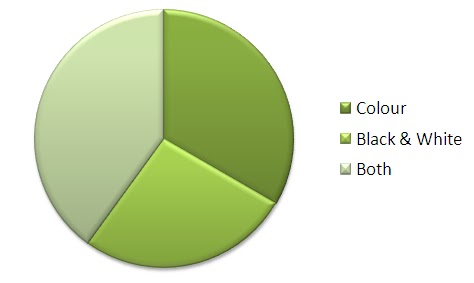 The results show that the people I questioned would want neither just colour or just black and white but a combination of both. This coincides well with my idea to shoot part of my thriller in black & white and colour to show two different passages of time. This technique was also used in Christopher Nolan's thriller "Memento".
4.) How much dialogue would you like there to be in the opening of our thriller?
 The response to this question gave a majority of 56% in favour there being not very much dialogue in the opening sequence of my thriller. I like this response because I believe the less dialogue, and the less information that is revealed throughout the opening, the more ambiguous and mysterious the thriller will become.
5.) What weapon would you prefer to include in our thriller?

6.) How fast would you like the editing to be?

7.) When would you prefer the title of the film to appear?

8.) Would you want the costumes for the characters to be smart or casual?

9.) Would you prefer the victim to be a male or a female?
 I was pleased with this response because we do want to break conventions within our thriller, and the convention of the female being the victim and damsel in distress is one that has always annoyed me. I am glad to be breaking the codes and conventions of the thriller genre and keeping the victim as a male.
10.) Would you want the acting to be more subtle than exaggerated?

Monday, 7 March 2011
Risk Assessment
The safety of the cast and crew of our thriller is paramount. To ensure that this is the case, we will have to be very careful when handling our props, the equipment and make sure we are generally safe in the locations we are filming in.
Risk:
During filming, the camera could be dropped and damaged.
Who/What is the risk?
The camera.
How can I prevent the risk?
I will make sure that when the camera is on the tripod, it will always be securely screwed on to ensure that it does not fall off and break, and we could lose valuable footage. When the tripod is not being used with the camera, I will hold it firmly in by hands and make it my priority to make sure I do not drop it. When the camera is not in use at all I will keep it in the case that came with it to ensure it does not get damaged.
Risk:
Tripping whilst filming the scene in the alley way.
Who/What is the risk?
Me who will be filming the scene.
How can I prevent the risk?
Make sure Zoran is behind me while I walk backwards with the camera to ensure I do not trip and fall over.
Risk:
Breaking the mug whilst filming.
Who/What is the risk?
The mug.
How can I prevent the risk?
We have identical mugs so it will not be too much of a disaster if we do break one. However, if we do break a mug it could injure someone on the cast and crew so we will be very careful that the mug is never left too close to the end of the worktop.
Risk:
Burning himself on the hot water from the kettle.
Who/What is the risk?
Cast/Crew.
How can I prevent this risk?
We must ensure we are very careful when handling the kettle, but if the unlikely happens, we are right next to a sink so we can use the cold water from the tap to treat the burns.
Sunday, 27 February 2011
Props
The props that I will use need to create the perfect mood and are very important to the mise en scene of the opening sequence.
Kettle
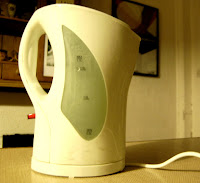 As the man is making a cup of coffee, we thought it would be interesting and somewhat necessary to include a kettle within the scene. As we are going to be shooting in Oliver's dad's kitchen, a kettle will not be hard to come by.
Mug

Gun
 The people who completed my questionaire thought that a gun would be the most perfect and classic prop to be used within a thriller. Also the shot at the end, which starts on the gun and ends with the shot of the dead character of Man 1, demonstrates to the audience that the man has been killed by Man 1.
Originally, I had intended to use a BB gun with a silencer, to imply that he could murder someone in his own house and not have people hear the loud gunshot. However, we discovered that we could not find this prop, so settled on the fact that the film is clearly shot in a suburban area, so a loud gunshot could be mistaken for a car backfiring etc.
Credits
The background on which the title of the thriller will be superimposed on has an interesting story. Oliver's father is a teaching assistant and he deals with children who have psychological problems. When he assigned a student in Year 4 to write a short story, he repeatedly wrote the word 'dead' on 3 sides of paper. I thought this was very disturbing.
I think this would be interesting to include in our thriller as it would show the psychotic nature of the character of Man 2. It also reminded me of a scene within the Horror/Thriller classic 'The Shining' (1980), where the character who we think has been writing a novel, has actually in fact been writing one phrase repeatedly over hundreds of sheets of paper.
Scene from 'The Shining' (1980): http://www.youtube.com/watch?v=oOBbJw0MLvk
Other props
We will need some milk, as the character is shown poring some into his coffee. This will not be hard to come by as we will be shooting in a kitchen. We also need a teaspoon and some coffee, and again this should not be hard to acquire.
Kettle
 As the man is making a cup of coffee, we thought it would be interesting and somewhat necessary to include a kettle within the scene. As we are going to be shooting in Oliver's dad's kitchen, a kettle will not be hard to come by.
 But the main reason the kettle is an important prop is because of the opening shot, of Man 2 flicking the switch on the kettle to boil the water - when the switch is flicked a red light comes on. The significance of red is danger and I used this very consciously.

The colour of the mug we will use has been thought out carefully. Because the opening sequence presents a character so deeply cut off from humanity that he could kill a man and then calmly make a cup of coffee, we have chosen a blue mug because it represents the cold-hearted nature of the character.
Gun

Originally, I had intended to use a BB gun with a silencer, to imply that he could murder someone in his own house and not have people hear the loud gunshot. However, we discovered that we could not find this prop, so settled on the fact that the film is clearly shot in a suburban area, so a loud gunshot could be mistaken for a car backfiring etc.
Credits
The background on which the title of the thriller will be superimposed on has an interesting story. Oliver's father is a teaching assistant and he deals with children who have psychological problems. When he assigned a student in Year 4 to write a short story, he repeatedly wrote the word 'dead' on 3 sides of paper. I thought this was very disturbing.
I think this would be interesting to include in our thriller as it would show the psychotic nature of the character of Man 2. It also reminded me of a scene within the Horror/Thriller classic 'The Shining' (1980), where the character who we think has been writing a novel, has actually in fact been writing one phrase repeatedly over hundreds of sheets of paper.
Scene from 'The Shining' (1980): http://www.youtube.com/watch?v=oOBbJw0MLvk
Other props
We will need some milk, as the character is shown poring some into his coffee. This will not be hard to come by as we will be shooting in a kitchen. We also need a teaspoon and some coffee, and again this should not be hard to acquire.
Cast for Opening Sequence
Casting is one of the most important processes within film making as the characters are often the driving force within the narrative. Our opening sequence of a thriller will include two characters, so I will be able to focus my efforts on casting more because of the minimal characters.
Character: Youth 1
Actor: Oliver Morroll

The first character I will be casting will be the character we see the most in the opening sequence. That is the character of the man walking up toward the house and knocking on the door, who I will call "Youth 1" as both characters names are never disclosed.
Oliver is perfect for the role as it takes some acting experience, which he has in abundance, having acted in a lot of short films we have made. We entered the George Spencer School Film Competition twice between 2008-2009, coming third in the first and second in the last, consistently being the only ones coming in the top three within those two years of the competition.
This the film in which we came second, 'Picture This' (2009) and shows some of his limited, but effective acting talents: http://www.youtube.com/watch?v=iLIVtP0voeY
Character: Youth 2
Actor: Jonathan Hawes

I do not have a lot of experience in acting but having directed a number of short films and I thought I could put my experience of the direction of others into my own performace.
Saturday, 26 February 2011
Rough Storyboard
This is the rough outline of my storyboard. I felt doing a rough sketch would help with my understanding of the plot, the characters, but especially the editing of the piece, as the success of the film depends largely on the pacing and the building of the tension.

This rough sketch shows the film opening with the man, who is approaching the house, opening the gate, and walking through it. I will later change the opening shot to an insert of the switch on the kettle being flicked on, to boil the water.
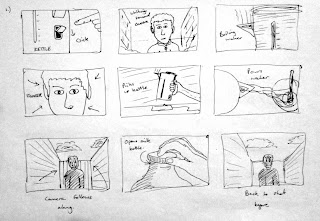
The first frame, shows that I intend to use the shot of the kettle switch as the first shot. The storyboard then continues from where the last page ended.
I intend to build the tension by starting on a medium shot of the man walking, which then cuts to a shot of the boiled kettle, then back to a close up of the walking man. This change from a medium shot, to a close up intensifies the scene and builds the tension.

The final stages of this storyboard shows the man reaching the doorway, intercut with the finishing of the making of the coffee. As the man knocks on the door, a figure appears and ask if the man would like some coffee. The shot then cuts to black for about 3-5 seconds to build the tension.
This black screen is also symbolic of the killing of the man. It also implies on the second viewing that the reason the audience are being given nothing in the way of image and sound is because this builds the tension; as humans in general are fearful of that which they cannot not fully understand or comprehend.
The final shot will be a challenge, also, as it is one long starting from the gun on the worktop all the way into the next room to reveal the dead man. Long takes are a technique I admire from thrillers, such as 'Goodfellas' (1990) and 'Reservoir Dogs' (1992) and are often used to reveal something about the character or the plot. In 'Goodfellas' (1990), the shot of Henry Hill entering the Copa Cobana shows his power and success and the entering into the glitsy, glamourous world of a gangster. The long take in 'Reservoir Dogs' (1992) which shows a bank robber walking from a warehouse, in which he is torchering a kidnapped police officer, outside to his car and back again juxtaposes the unbeliavable, larger-than-life events that are occuring in the warehouse and the mundane peacefullness of suburban life outside of it.
My film will incorporate the idea of showing that while something everyday and ordinary could be happening in one room, something terrifying and violent could be occuring in the next. Which is why I will juxtapose the shot of a man drinking his coffee, with a dead body in the next room.
The long take from Goodfellas (1990):
http://www.youtube.com/watch?v=e8DPiHCtQCw&feature=related
The long take from Reservoir Dogs (1992):
[shot begins at 2:58]
http://www.youtube.com/watch?v=komvFIGYBYM&feature=related

This rough sketch shows the film opening with the man, who is approaching the house, opening the gate, and walking through it. I will later change the opening shot to an insert of the switch on the kettle being flicked on, to boil the water.
Overall, this demonstrates that the idea of intercutting between the two actions is still firmly in place.

The first frame, shows that I intend to use the shot of the kettle switch as the first shot. The storyboard then continues from where the last page ended.
I intend to build the tension by starting on a medium shot of the man walking, which then cuts to a shot of the boiled kettle, then back to a close up of the walking man. This change from a medium shot, to a close up intensifies the scene and builds the tension.

The final stages of this storyboard shows the man reaching the doorway, intercut with the finishing of the making of the coffee. As the man knocks on the door, a figure appears and ask if the man would like some coffee. The shot then cuts to black for about 3-5 seconds to build the tension.
This black screen is also symbolic of the killing of the man. It also implies on the second viewing that the reason the audience are being given nothing in the way of image and sound is because this builds the tension; as humans in general are fearful of that which they cannot not fully understand or comprehend.
The final shot will be a challenge, also, as it is one long starting from the gun on the worktop all the way into the next room to reveal the dead man. Long takes are a technique I admire from thrillers, such as 'Goodfellas' (1990) and 'Reservoir Dogs' (1992) and are often used to reveal something about the character or the plot. In 'Goodfellas' (1990), the shot of Henry Hill entering the Copa Cobana shows his power and success and the entering into the glitsy, glamourous world of a gangster. The long take in 'Reservoir Dogs' (1992) which shows a bank robber walking from a warehouse, in which he is torchering a kidnapped police officer, outside to his car and back again juxtaposes the unbeliavable, larger-than-life events that are occuring in the warehouse and the mundane peacefullness of suburban life outside of it.
My film will incorporate the idea of showing that while something everyday and ordinary could be happening in one room, something terrifying and violent could be occuring in the next. Which is why I will juxtapose the shot of a man drinking his coffee, with a dead body in the next room.
The long take from Goodfellas (1990):
http://www.youtube.com/watch?v=e8DPiHCtQCw&feature=related
The long take from Reservoir Dogs (1992):
[shot begins at 2:58]
http://www.youtube.com/watch?v=komvFIGYBYM&feature=related
Mind Map

This lesson allowed us as a group to organise our ideas for the opening of a thriller. We outlined the basic idea: a man casually makes a cup of coffee, and the camera slowly tracks into the next room to reveal the corpse of a man, lying dead on the sofa. This is shown on the right hand side of the page.
Oliver then expanded upon this idea (see left hand side of page) by suggesting this be intercut with footage of the man we see dead at the end of the film, walking to the house, up the drive and knocking on the door, where he is then greeted by his killer. We have decided this will be our final idea.
I will now assemble a rough storyboard. The reason I will be making a rough storyboard, is one: so I can organise my thoughts, and two: so I can plan the pacing and cutting of the shots.
Thriller Conventions
To replicate the opening two minutes of a thriller, I will have to have knowlege of the codes and conventions of the thriller genre.
List of conventions for Thrillers:
- The takes are either very short to thrill the audience with the pace and excitement, or very long to build the suspense and expectation.
- They often include villains and victims. Villains are often the most important, however, as they push the plot forward. The victims are often of minor significance, there existence based only around there death within the film.
- The brutality of the events is often implied through the use of quick, fast paced cuts.
- The narrative is often mysterious, with varying twists and turns in the plot that keeps the audience guessing until the very end of the film.
- The narrative is often based around a crime of some sort, such as 'Psycho' (1960).
- The location or content of the scene can be recognisable to audience, but is then often turned on its head in a brutal fashion to unsettle the audience.
List of conventions for Thrillers:
- The takes are either very short to thrill the audience with the pace and excitement, or very long to build the suspense and expectation.
- They often include villains and victims. Villains are often the most important, however, as they push the plot forward. The victims are often of minor significance, there existence based only around there death within the film.
- The brutality of the events is often implied through the use of quick, fast paced cuts.
- The narrative is often mysterious, with varying twists and turns in the plot that keeps the audience guessing until the very end of the film.
- The narrative is often based around a crime of some sort, such as 'Psycho' (1960).
- The location or content of the scene can be recognisable to audience, but is then often turned on its head in a brutal fashion to unsettle the audience.
Friday, 18 February 2011
Target Audience - Thriller Genre
 Different films within the thriller genre have different target audience and appeal to either a specific gender or age. From my research, I have discovered that it is mostly males that are the target audience for thrillers. However, that is not to say that females do not enjoy the genre. For the 1999 film "Fight Club", the IMDb's ratings show that males gave an average vote of 8.9/10, with females not far behind, rating it 8.7/10.
  The votes for "Pulp Fiction" (1994) on IMDb show that the highest ratings are from males under 18, at 9.4/10. This implies that the thriller genre is primarily aimed at teenage males who are willing to be shocked with violence and gore. This can be proven with the votes for females aged 45+, which came to a significantly less rating of 8.3/10. Yet the males are still the predominant target of this age group, with the ratings for females aged 45+ coming to 7.6/10.
 The voting figures for the 1976 thriller "Taxi Driver" show that males have 125,036 votes, and females only have 12,775. This demonstrates that it is mainly males who have watched this film.
However, the thriller genre has sub genres which all target different audiences depending on age or gender. A film like "The Silence of the Lambs", which portrays the vulnerabilty and strength of a woman in a profession that has mostly male employees, the FBI. This realistic and modern portrayl of women defies the general concept that females sould be the damsels in distress and a challenge for the male characters to rescue. It also shows in the viewer ratings on IMDb that there is an equal vote of 8.7/10 between male and females.
Overall, thrillers are predominantly aimed at young males, but the sub genres, such as a horror/thriller (mostly aimed at teenage girls, e.g. Twilight) allows for females to enjoy this type of film as much as the teenage boy does.
Thriller Research

History/Background:
The main elements of the thriller genre are the use of suspense, tension and excitement.
Prime subgenres are mystery, crime and psychological thrillers.
A thriller is a villain-driven plot, whereby he presents obstacles the hero must overcome.
“A genuine, standalone thriller is a film that provide thrills and keeps the audience cliff-hanging at the "edge of their seats" as the plot builds towards a climax. The tension usually arises when the character(s) is placed in a menacing situation, a mystery, or a trap from which escaping seems impossible. Life is threatened, usually because the principal character is unsuspectingly or unknowingly involved in a dangerous or potentially deadly situation.”
“These are types of films known to promote intense excitement, suspense, a high level of anticipation, ultra-heightened expectation, uncertainty, anxiety, and nerve-wracking tension. Thriller and suspense films are virtually synonymous and interchangeable categorizations, with similar characteristics and features.”
Thrillers often include themes such as political conspiracy, terrorism, or romantic triangles with the end result often being a murder.
Key films:
- Psycho (1960)
- Se7en (1995)
- Memento (2000)
- Rear Window (1954)
- Vertigo (1958)
- No Country for Old Men (2007)
- The Silence of the Lambs (1991)
Key directors:
- Alfred Hitchcock
- David Fincher
- Stanley Kubrick
- Martin Scorsese
- Brian De Palmer
- Ridley Scott
Key actors:
- Cary Grant
- Robert De Niro
- Janet Leigh
- James Stewart
- Leonardo Di Caprio
- Jack Nicholson
Sub genres and contemporary examples:
Some thrillers include elements of other genres, such as:
- Crime thriller (Hostage, Ocean’s 11)
- Disaster thriller (Poseidon, Knowing)
- Mystery thriller (Shutter Island)
- Legal thriller (A Few Good Men)
- Erotic thriller (Eyes Wide Shut, In the Cut)
- Psychological thriller (Misery, Cape Fear)
Friday, 4 February 2011
Analysis of Se7en (1995) - Opening Sequence
Se7en (1995)
 Mise en Scene
The use of shadows, when we see the picture of the deformed hands creates a sense of tension and mystery and the audience does not know specifically whose hands these are. It also makes the audience want to carry on watching to find out.
Technical Codes
Fast paced editing builds the tension as it implies the quick thinking, quick acting, psychotic mind of the character who will be revealed to be John Doe, the serial killer in the film.
Over layering of shots during the titles sequence builds the ambiguity and implies the chaotic nature that will follow in the rest of the film.
Narratives/Plot
A sense of narrative and plot is unclear within the opening title sequence. It is clear we are seeing snapshots of the life of a very sick man and this makes the audience feels unsettled and curious.
Characters/Locations
It is revealed to the audience that the man within the opening title sequence is a very disturbed man. He is shown cutting the skin off the tips of his fingernails and highlighted passages of the bible. This conjures connotations of an metally unstable, bizarre, religous character.
Analysis of 'Psycho' (1960)
http://www.youtube.com/watch?v=Tek8QmKRODw
Psycho (1960)

Technical Codes
The opening title sequence uses quick editing, with the credits whizzing on and off screen, with a fast paced, screeching strings soundtrack, composed by Bernard Hermann. This builds tension as the music is intense and ambiguous.
The camera uses a series of shots to focus from the vastness of the city scape to the apartment window, which seems dark and empty. This creates suspense as the audience is made to wonder what is in the apartment.
Narratives/Plot
The title sequence implies chaotic horror, which is then juxtaposed with the calm landscape of a city. The music has now changed to dreamy, but it still has an underlying threat to it. The nature of the plot is unclear from the opening sequence but it is clear we are focusing on someone from a city.
Characters/Locations
The city implies that the character is hard working and is not happy, as her life is dependant on work.
Psycho (1960)

Mise en Scene
After the title sequence, Hitchcock cuts to an establishing shot of a city. The scene is set in the day and is meant to imply the calm before the storm. This builds tension within the audience as they are on the edge of their seat, waiting for something to happen, which the music at the beginning implied.
Technical Codes
The opening title sequence uses quick editing, with the credits whizzing on and off screen, with a fast paced, screeching strings soundtrack, composed by Bernard Hermann. This builds tension as the music is intense and ambiguous.
The camera uses a series of shots to focus from the vastness of the city scape to the apartment window, which seems dark and empty. This creates suspense as the audience is made to wonder what is in the apartment.
Narratives/Plot
The title sequence implies chaotic horror, which is then juxtaposed with the calm landscape of a city. The music has now changed to dreamy, but it still has an underlying threat to it. The nature of the plot is unclear from the opening sequence but it is clear we are focusing on someone from a city.
Characters/Locations
The city implies that the character is hard working and is not happy, as her life is dependant on work.
Wednesday, 2 February 2011
Storyboard Screenshots/Analysis
22/1/11
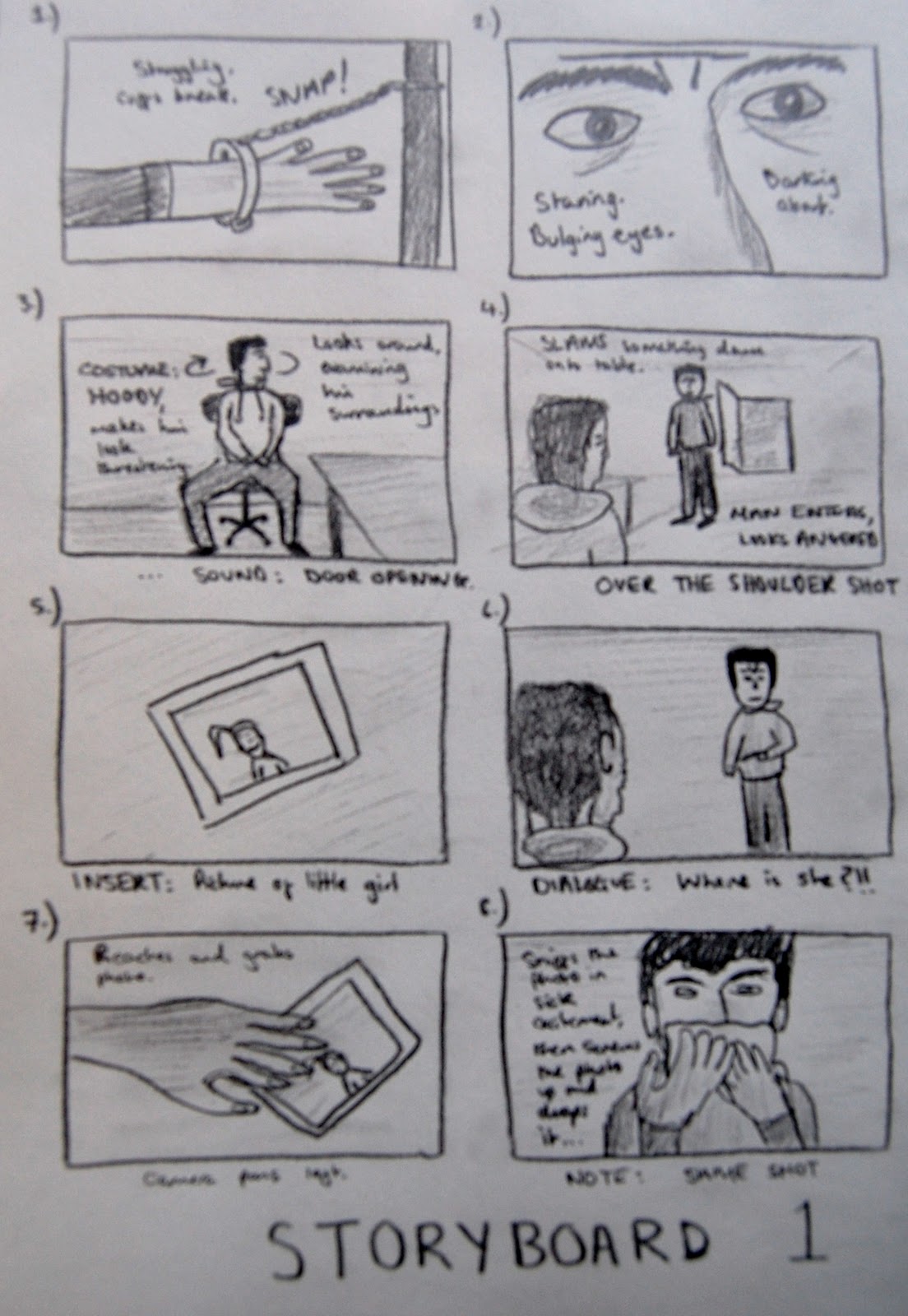

This is our storyboard. We have indicated props and also parts of the costume such as the murderer should where a hoody as it makes him look threatening and like a thug. We also addressed editing techniques such as the cut to black at the end of the film to build the tension and suspense within the audience so they do not know what has happened. In our storyboard, we have also incorporated filming techniques such as panning, point of view, insert shot, low angle and close up shots (eye shot).
We are almost ready to start filming as soon as possible, now our main goal is to organise props and costume to film within lesson time. This storyboard provides the backbone for our film and it will be used like a Bible when filming commences.
Preliminary Task
FINAL EDIT:
Finishing Storyboard
21/1/11
Once we had all established the main parts of our task, such as the basic story and shots, we began to think about props and sound. We realised we would need a sound effect for when the man slaps the murderer. Also we realised we would need a set of handcuffs as a prop as the entire crux of the story was based around the fact that as the film opens we realise that the murderer has freed himself from the cuffs that are holding him to be interrogated. It also implies he is a very dangerous person. Oliver realised that his younger brother had some handcuffs, and he said he is going to bring them in on the day of filming.
Once we had all established the main parts of our task, such as the basic story and shots, we began to think about props and sound. We realised we would need a sound effect for when the man slaps the murderer. Also we realised we would need a set of handcuffs as a prop as the entire crux of the story was based around the fact that as the film opens we realise that the murderer has freed himself from the cuffs that are holding him to be interrogated. It also implies he is a very dangerous person. Oliver realised that his younger brother had some handcuffs, and he said he is going to bring them in on the day of filming.
Monday, 31 January 2011
Storyboard
17/1/11
Today we began our storyboard. I decided to work with Zoran Markovic and Oliver Morroll. We also chose to use Will Stevenson, a student from another AS Media class as our actor, as he is a very good performer.
We detailed shots, camera angles, props and costumes in our storyboard. We decided that our film would be about a killer who is captured by the father of a girl he murdered. The storyboard has not yet been finished, but we will finish it ASAP.
Today we began our storyboard. I decided to work with Zoran Markovic and Oliver Morroll. We also chose to use Will Stevenson, a student from another AS Media class as our actor, as he is a very good performer.
We detailed shots, camera angles, props and costumes in our storyboard. We decided that our film would be about a killer who is captured by the father of a girl he murdered. The storyboard has not yet been finished, but we will finish it ASAP.
Subscribe to:
Posts (Atom)