Friday, 18 February 2011

Thriller Research


History/Background:
The main elements of the thriller genre are the use of suspense, tension and excitement.
Prime subgenres are mystery, crime and psychological thrillers.
A thriller is a villain-driven plot, whereby he presents obstacles the hero must overcome.
“A genuine, standalone thriller is a film that provide thrills and keeps the audience cliff-hanging at the "edge of their seats" as the plot builds towards a climax. The tension usually arises when the character(s) is placed in a menacing situation, a mystery, or a trap from which escaping seems impossible. Life is threatened, usually because the principal character is unsuspectingly or unknowingly involved in a dangerous or potentially deadly situation.”
“These are types of films known to promote intense excitement, suspense, a high level of anticipation, ultra-heightened expectation, uncertainty, anxiety, and nerve-wracking tension. Thriller and suspense films are virtually synonymous and interchangeable categorizations, with similar characteristics and features.”
Thrillers often include themes such as political conspiracy, terrorism, or romantic triangles with the end result often being a murder.

Key films:
-       Psycho (1960)
-       Se7en (1995)
-       Memento (2000)
-       Rear Window (1954)
-       Vertigo (1958)
-       No Country for Old Men (2007)
-       The Silence of the Lambs (1991)

Key directors:
-       Alfred Hitchcock
-       David Fincher
-       Stanley Kubrick
-       Martin Scorsese
-       Brian De Palmer
-       Ridley Scott

Key actors:
-       Cary Grant
-       Robert De Niro
-       Janet Leigh
-       James Stewart
-       Leonardo Di Caprio
-       Jack Nicholson

Sub genres and contemporary examples:
Some thrillers include elements of other genres, such as:
-       Crime thriller (Hostage, Ocean’s 11)
-       Disaster thriller (Poseidon, Knowing)
-       Mystery thriller (Shutter Island)
-       Legal thriller (A Few Good Men)
-       Erotic thriller (Eyes Wide Shut, In the Cut)
-       Psychological thriller (Misery, Cape Fear)


Friday, 4 February 2011

Analysis of Se7en (1995) - Opening Sequence


Se7en (1995)

Mise en Scene

The use of shadows, when we see the picture of the deformed hands creates a sense of tension and mystery and the audience does not know specifically whose hands these are. It also makes the audience want to carry on watching to find out.

Technical Codes

Fast paced editing builds the tension as it implies the quick thinking, quick acting, psychotic mind of the character who will be revealed to be John Doe, the serial killer in the film.

Over layering of shots during the titles sequence builds the ambiguity and implies the chaotic nature that will follow in the rest of the film.

Narratives/Plot

A sense of narrative and plot is unclear within the opening title sequence. It is clear we are seeing snapshots of the life of a very sick man and this makes the audience feels unsettled and curious.

Characters/Locations

It is revealed to the audience that the man within the opening title sequence is a very disturbed man. He is shown cutting the skin off the tips of his fingernails and highlighted passages of the bible. This conjures connotations of an metally unstable, bizarre, religous character.

Analysis of 'Psycho' (1960)

http://www.youtube.com/watch?v=Tek8QmKRODw

Psycho (1960)

Mise en Scene

After the title sequence, Hitchcock cuts to an establishing shot of a city. The scene is set in the day and is meant to imply the calm before the storm. This builds tension within the audience as they are on the edge of their seat, waiting for something to happen, which the music at the beginning implied.

Technical Codes

The opening title sequence uses quick editing, with the credits whizzing on and off screen, with a fast paced, screeching strings soundtrack, composed by Bernard Hermann. This builds tension as the music is intense and ambiguous.

The camera uses a series of shots to focus from the vastness of the city scape to the apartment window, which seems dark and empty. This creates suspense as the audience is made to wonder what is in the apartment.

Narratives/Plot

The title sequence implies chaotic horror, which is then juxtaposed with the calm landscape of a city. The music has now changed to dreamy, but it still has an underlying threat to it. The nature of the plot is unclear from the opening sequence but it is clear we are focusing on someone from a city.

Characters/Locations

The city implies that the character is hard working and is not happy, as her life is dependant on work.

Wednesday, 2 February 2011

Storyboard Screenshots/Analysis

22/1/11


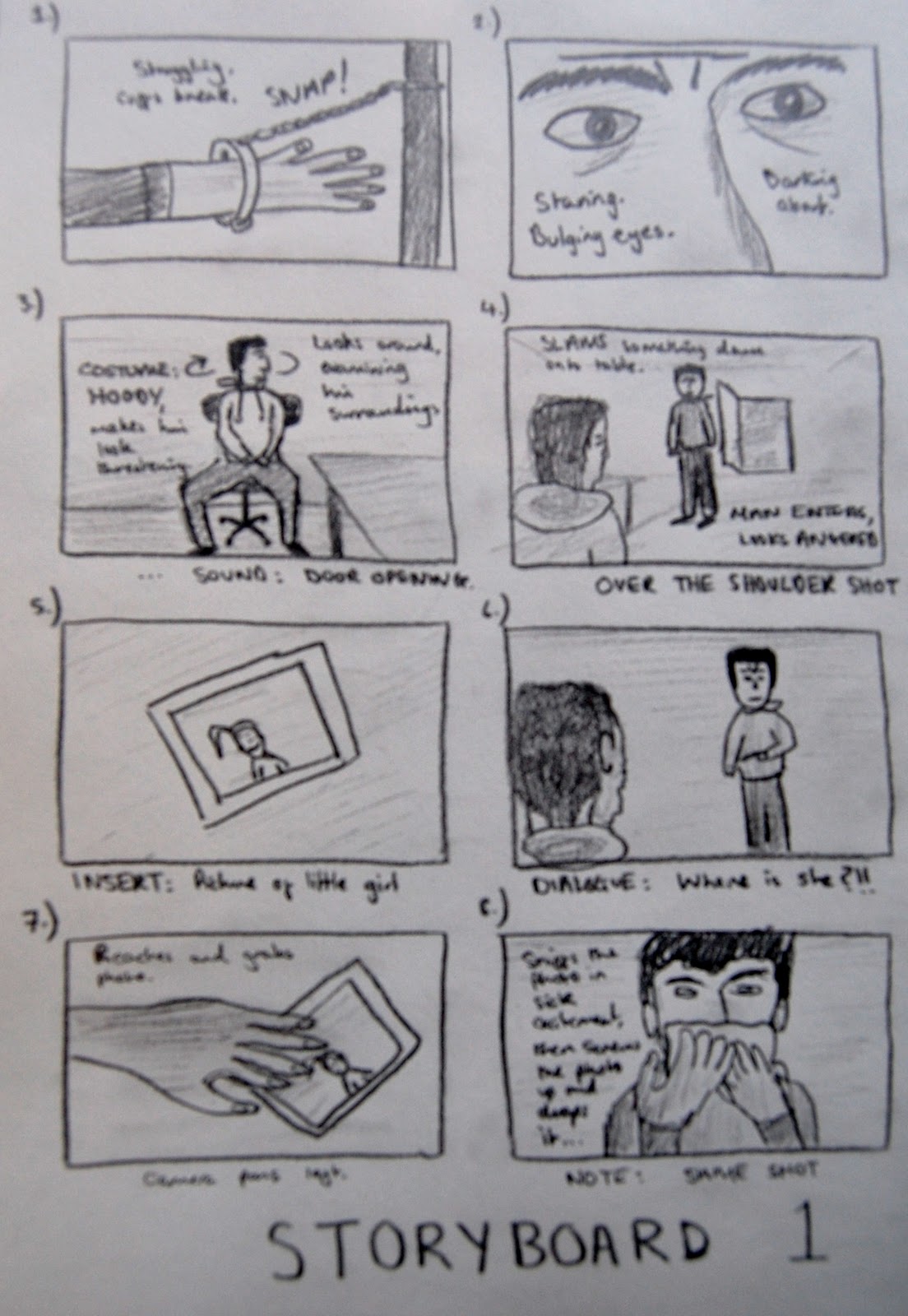
This is our storyboard. We have indicated props and also parts of the costume such as the murderer should where a hoody as it makes him look threatening and like a thug. We also addressed editing techniques such as the cut to black at the end of the film to build the tension and suspense within the audience so they do not know what has happened. In our storyboard, we have also incorporated filming techniques such as panning, point of view, insert shot, low angle and close up shots (eye shot).

We are almost ready to start filming as soon as possible, now our main goal is to organise props and costume to film within lesson time. This storyboard provides the backbone for our film and it will be used like a Bible when filming commences.

Preliminary Task
FINAL EDIT:

Finishing Storyboard

21/1/11

Once we had all established the main parts of our task, such as the basic story and shots, we began to think about props and sound. We realised we would need a sound effect for when the man slaps the murderer. Also we realised we would need a set of handcuffs as a prop as the entire crux of the story was based around the fact that as the film opens we realise that the murderer has freed himself from the cuffs that are holding him to be interrogated. It also implies he is a very dangerous person. Oliver realised that his younger brother had some handcuffs, and he said he is going to bring them in on the day of filming.

Monday, 31 January 2011

Storyboard

17/1/11

Today we began our storyboard. I decided to work with Zoran Markovic and Oliver Morroll. We also chose to use Will Stevenson, a student from another AS Media class as our actor, as he is a very good performer. 

We detailed shots, camera angles, props and costumes in our storyboard. We decided that our film would be about a killer who is captured by the father of a girl he murdered. The storyboard has not yet been finished, but we will finish it ASAP.